THE MAN WHO MISTOOK HIS WIFE FOR A HAT
AND OTHER CLINICAL TALES
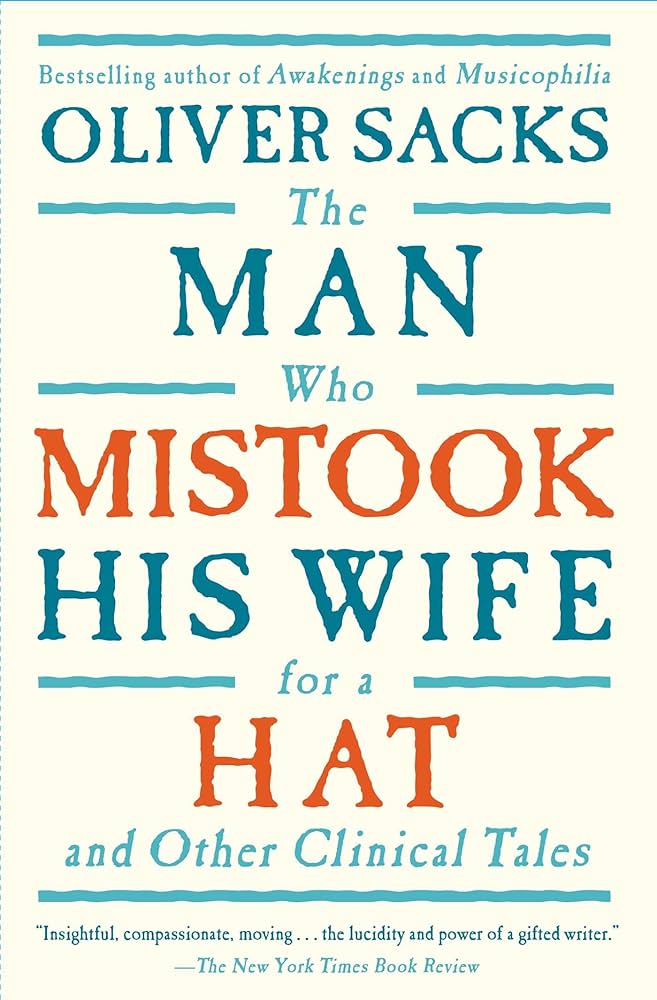
The Man Who Mistook His Wife for a Hat and Other Clinical Tales is a 1985 book by neurologist Oliver Sacks presenting narratives based on some of his patients. Sacks chose the title of the book from the case study of one of his patients who has visual agnosia,[1] a neurological condition that leaves him unable to recognize faces and objects. The book became the basis of an opera of the same name by Michael Nyman, which premiered in 1986. While the book is often categorized as nonfiction, Sacks’ private journals and correspondences have revealed that he embellished or fabricated some of its content.[2]
The book comprises twenty-four essays split into four sections (“Losses”, “Excesses”, “Transports”, and “The World of the Simple”), each dealing with a particular aspect of brain function. The first two sections discuss deficits and excesses (with particular emphasis on the right hemisphere of the brain), while the third and fourth sections describe phenomenological manifestations with reference to spontaneous reminiscences, altered perceptions, and extraordinary qualities of mind found in people with intellectual disabilities.[3]
In addition to describing the cases, Sacks comments on them, explains their pathophysiological background, discusses potential neuroscientific implications of such cases and occasionally makes reference to some psychological concepts, such as the soul, id, ego, and super-ego.
In 2025, The New Yorker reported that Sacks considered the book to be riddled with falsifications and felt guilty over its success.[2]
Sacks dedicated the book to Leonard Shengold, M.D.